
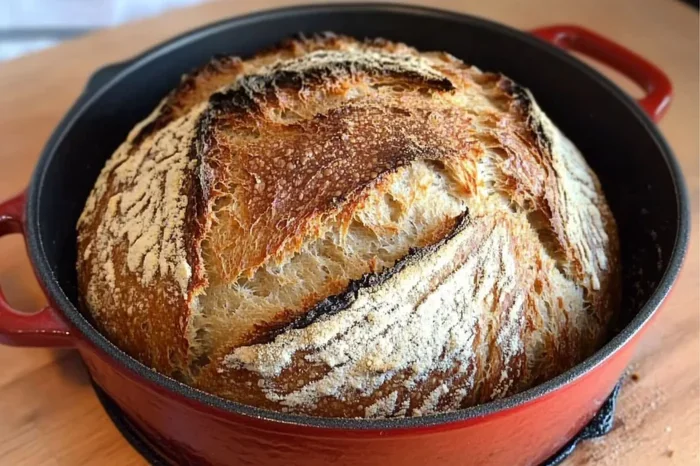
How Big Should a Dutch Oven Be for Sourdough
Choosing the right Dutch oven size for sourdough is one of the most important decisions a home baker can make. A 5 to 6-quart round Dutch oven is the ideal size for most standard sourdough loaves, providing enough room for proper oven spring while trapping steam effectively. This guide breaks down everything you need to know about Dutch oven sizing for sourdough bread, so you can bake with confidence.
If you’ve ever pulled a flat, dense sourdough loaf out of the oven and wondered what went wrong, the answer might be simpler than you think. It could be your Dutch oven size. Choosing the right Dutch oven for sourdough bread makes a dramatic difference in how your loaf rises, how the crust develops, and how the crumb turns out.
Many home bakers invest hours perfecting their starter, mastering their stretch and fold technique, and dialing in fermentation times — only to overlook the vessel that holds it all together. The Dutch oven acts as a mini steam chamber in your home oven, mimicking the conditions of a professional bread oven. But if it’s too small, your dough won’t have room to expand. Too large, and the steam escapes before it can work its magic.
In this guide, we’ll walk you through everything you need to know about Dutch oven sizing for sourdough, including the ideal capacity, shape considerations, and how to match your pot to your loaf size. Whether you’re baking your first loaf or your hundredth, this information will help you get consistent, bakery-quality results.
- 5 to 6 quarts is the sweet spot: This size accommodates a 1.5 to 2-pound sourdough loaf with room for oven spring and proper steam circulation.
- Round shape is preferred: A round Dutch oven matches the shape of most artisan sourdough loaves and distributes heat evenly.
- Minimum 4-quart size: Anything smaller than 4 quarts restricts loaf expansion and limits your baking options.
- Consider your loaf weight: Match your Dutch oven size to your dough weight — larger loaves need more headroom for proper rise.
- Enameled cast iron works best: It retains heat well, creates a beautiful crust, and is easier to maintain than bare cast iron.
- Oval Dutch ovens are an alternative: They work well for batard-shaped loaves but may not trap steam as efficiently as round models.
- Preheating is essential: Regardless of size, always preheat your Dutch oven for at least 30 minutes for the best crust development.
Quick Answers to Common Questions
What size Dutch oven is best for sourdough bread?
A 5 to 6-quart round Dutch oven is ideal for most sourdough loaves. It provides enough room for oven spring while trapping steam effectively around the dough.
Can I bake sourdough in a 3-quart Dutch oven?
You can, but only for very small loaves made with about 400g of flour or less. A 3-quart pot restricts expansion and limits your baking options significantly.
Is round or oval better for sourdough?
Round is generally better for boule-shaped loaves because it matches the shape and traps steam more efficiently. Oval works well for batard-shaped loaves.
How much dough can a 5-quart Dutch oven handle?
A 5-quart Dutch oven comfortably handles loaves made with 750g to 1000g of flour, which typically weigh 1.5 to 2 pounds after baking.
Do I need an enameled Dutch oven for sourdough?
Enameled cast iron is preferred because it’s easier to maintain and doesn’t affect flavor. However, a well-seasoned bare cast iron Dutch oven also works well.
📑 Table of Contents
- Why Dutch Oven Size Matters for Sourdough Bread
- The Ideal Dutch Oven Size for Sourdough
- Round vs. Oval: Which Shape Is Better for Sourdough?
- Material Considerations: Enameled vs. Bare Cast Iron
- Common Mistakes When Choosing a Dutch Oven for Sourdough
- Expert Tips for Baking Sourdough in a Dutch Oven
- Can You Bake Sourdough Without a Dutch Oven?
- Frequently Asked Questions About Dutch Oven Size for Sourdough
- Conclusion: Finding Your Perfect Dutch Oven Match
Why Dutch Oven Size Matters for Sourdough Bread
Understanding why size matters starts with knowing what a Dutch oven actually does during baking. When you place a loaf inside a preheated Dutch oven and put the lid on, you create a sealed environment. The moisture from your dough turns to steam, and that steam is trapped inside the pot.
This trapped steam is critical for sourdough. It keeps the surface of the dough flexible during the first phase of baking, allowing the loaf to expand fully — what bakers call oven spring. Without enough steam, the crust forms too early, and the loaf can’t reach its full potential.
The Steam Factor
Steam does more than just help the loaf rise. It also contributes to a glossy, crackly crust — the kind that shatters when you slice into it. A Dutch oven that’s the right size traps steam efficiently around the dough. If the pot is too large, steam disperses into the empty space and doesn’t surround the loaf properly.
Think of it like this: a snug fit means more steam contact with the dough surface. A loose fit means wasted steam and a less impressive crust.
Heat Retention and Distribution
Cast iron is famous for its ability to hold and distribute heat evenly. But the size of your Dutch oven affects how that heat behaves. A properly sized pot maintains a consistent temperature around the entire loaf. This even heat distribution is what gives sourdough its characteristic golden-brown crust on all sides.
A pot that’s too small forces the dough to touch the walls, which can create hot spots and uneven browning. A pot that’s too large allows too much air circulation, which can cool the environment and slow down crust formation.
The Ideal Dutch Oven Size for Sourdough
So, how big should a Dutch oven be for sourdough? The answer depends on the size of your loaf, but there are some general guidelines that work for most home bakers.
The 5 to 6-Quart Sweet Spot
For the vast majority of home sourdough bakers, a 5 to 6-quart Dutch oven is the ideal choice. This size comfortably handles a 1.5 to 2-pound loaf of dough — which is the standard size for most sourdough recipes.
Here’s why this range works so well:
- It provides enough headroom for the loaf to rise without hitting the lid
- It traps steam effectively around the dough
- It distributes heat evenly for consistent browning
- It’s versatile enough for other recipes beyond bread
Popular models in this range include the Lodge 5-Quart Dutch Oven and the Le Creuset 5.5-Quart Round Dutch Oven. Both are excellent choices that serious home bakers swear by.
Matching Dutch Oven Size to Dough Weight
A good rule of thumb is to choose a Dutch oven with a capacity that’s roughly 3 to 4 times the weight of your dough. This ratio gives the loaf plenty of room to expand while keeping the steam concentrated.
Here’s a quick reference:
- 500g flour recipes (about 1 lb loaf): 4-quart Dutch oven minimum
- 750g flour recipes (about 1.5 lb loaf): 5-quart Dutch oven recommended
- 1000g flour recipes (about 2 lb loaf): 6-quart Dutch oven recommended
- 1200g+ flour recipes (large loaves): 7-quart or larger Dutch oven
If you frequently bake different sized loaves, owning two Dutch ovens — one 5-quart and one 6-quart — gives you the most flexibility.
What About Smaller Dutch Ovens?
You can technically bake sourdough in a 3 or 4-quart Dutch oven, but you’ll be limited to smaller loaves. A 3-quart pot works for a single small boule made with about 400g of flour. However, the margin for error is smaller. The dough has less room to expand, and it’s easier to end up with a loaf that hits the lid.
If you’re just starting out and want to practice with smaller batches, a 4-quart Dutch oven is a reasonable entry point. But if you’re serious about sourdough, investing in a 5 or 6-quart model from the start will save you from upgrading later.
Round vs. Oval: Which Shape Is Better for Sourdough?
Size isn’t the only factor — shape matters too. Dutch ovens come in two main shapes: round and oval. Each has its advantages for sourdough baking.
Round Dutch Ovens
The round Dutch oven is the most popular choice for sourdough, and for good reason. Most artisan sourdough loaves are shaped as boules — round, dome-shaped loaves. A round pot matches this shape perfectly, creating an even gap between the dough and the walls on all sides.
Benefits of round Dutch ovens:
- Even heat distribution around the entire loaf
- Better steam retention due to the symmetrical shape
- Matches the shape of a standard boule
- Widely available in the ideal 5 to 6-quart range
If you primarily bake round sourdough loaves, a round Dutch oven is the way to go.
Oval Dutch Ovens
Oval Dutch ovens are excellent for batard-shaped loaves — the elongated, oval-shaped sourdough that’s become increasingly popular. An oval pot gives the batard room to expand lengthwise without being cramped.
However, oval Dutch ovens have a few drawbacks for sourdough:
- Steam may escape more easily around the longer shape
- Heat distribution can be less even compared to round models
- They’re often larger in capacity, which can dilute steam concentration for smaller loaves
That said, if you love baking batards, a 6 to 7-quart oval Dutch oven can produce excellent results. Just make sure to preheat it thoroughly and consider adding a small ice cube to boost steam production.
Material Considerations: Enameled vs. Bare Cast Iron
The material of your Dutch oven also plays a role in sourdough success. Most Dutch ovens are made from cast iron, but there are two main types: enameled cast iron and bare (raw) cast iron.
Enameled Cast Iron
Enameled Dutch ovens like Le Creuset, Staub, and Lodge Enameled are the top choice for sourdough bakers. The enamel coating creates a smooth, non-reactive surface that’s easy to clean and doesn’t require seasoning.
Advantages for sourdough:
- Consistent heat retention and distribution
- No risk of metallic flavors transferring to the dough
- Easy to clean — no special maintenance required
- Beautiful crust development due to steady heat
If you want a deeper dive into caring for these pots, check out our guide on how to clean a Dutch oven for expert tips that keep your cookware in top shape.
Bare Cast Iron
Bare cast iron Dutch ovens are less expensive and can produce excellent results, but they require more maintenance. You’ll need to season them regularly to maintain a non-stick surface and prevent rust.
The main concern with bare cast iron for sourdough is that the seasoning can sometimes affect the flavor of the crust, especially when the pot is new. Once well-seasoned, though, bare cast iron performs nearly as well as enameled.
For those who already own a bare cast iron pot, our article on how to season a Dutch oven perfectly will help you get it bread-baking ready.
Common Mistakes When Choosing a Dutch Oven for Sourdough
Even experienced bakers sometimes make errors when selecting or using a Dutch oven. Here are the most common mistakes to avoid.
Going Too Small
The number one mistake is choosing a Dutch oven that’s too small for the loaf. When dough doesn’t have room to expand, it presses against the walls and lid, resulting in a flat, dense loaf with poor oven spring. Always err on the side of slightly larger rather than too small.
Ignoring the Lid Fit
A tight-fitting lid is essential for steam retention. Some Dutch ovens have lids that sit loosely or have a small vent hole. While a tiny vent is fine, a lid that doesn’t seal well will let steam escape and reduce the effectiveness of the Dutch oven method.
Look for lids that sit flush on the rim. Some bakers even place a sheet of parchment between the lid and the pot for an extra-tight seal.
Not Preheating Long Enough
Regardless of size, a Dutch oven needs to be fully preheated before the dough goes in. Most bakers preheat for 30 to 45 minutes at the baking temperature. Skipping this step or cutting it short means the pot won’t deliver the intense initial heat needed for proper oven spring.
Using the Wrong Shape for Your Loaf
Baking a batard in a round Dutch oven or a boule in an oval one isn’t the end of the world, but it won’t give you the best results. Match your pot shape to your loaf shape whenever possible for the most even bake.
Expert Tips for Baking Sourdough in a Dutch Oven
Now that you know how to choose the right size, here are some pro tips to elevate your Dutch oven sourdough game.
Score Your Dough Deeply
Scoring isn’t just decorative — it controls where the loaf expands. In a Dutch oven, the confined space means the dough will expand rapidly. A deep, confident score (about ¼ to ½ inch deep) gives the steam and heat a clear path to push the dough upward.
Use Parchment Paper
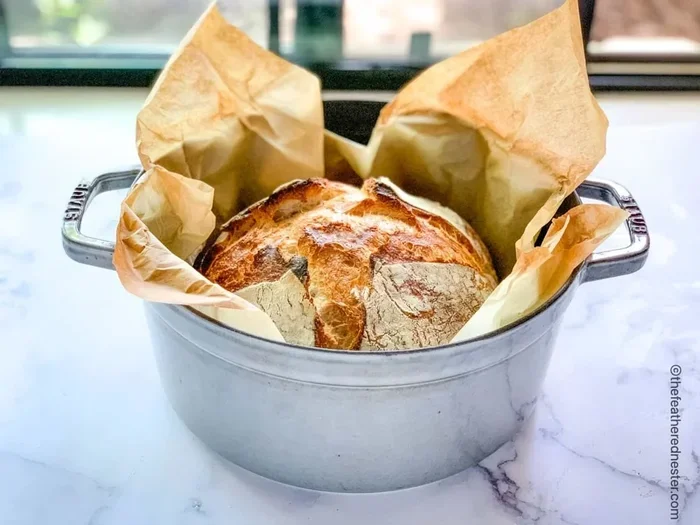
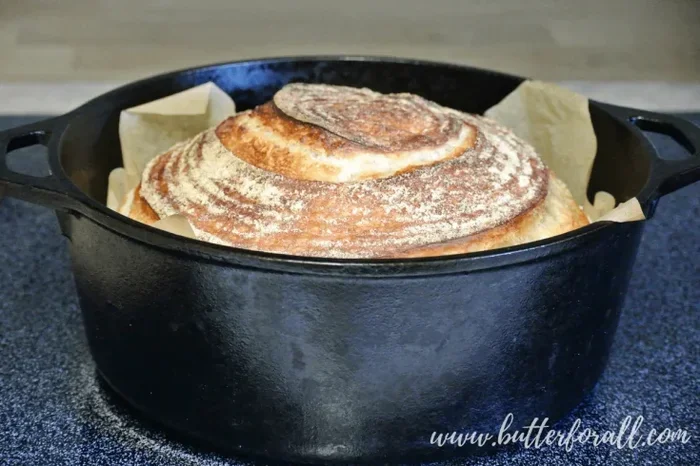
Lining your Dutch oven with parchment paper makes it much easier to transfer the dough without deflating it. It also prevents sticking and makes cleanup a breeze. Just cut a piece of parchment slightly wider than your loaf and use it as a sling to lower the dough into the hot pot.
Adjust Your Baking Time
A typical sourdough bake in a Dutch oven follows this pattern:
- 20-25 minutes with the lid on: This is the steam phase where oven spring happens
- 15-20 minutes with the lid off: This is the browning phase where the crust develops color and crunch
The exact times depend on your oven temperature and loaf size, but this framework works well for most recipes.
Consider a Baking Stone Underneath
Placing your Dutch oven on a preheated baking stone or steel adds extra bottom heat. This helps create a crispier bottom crust — something that can sometimes be lacking when baking in a Dutch oven alone.
Can You Bake Sourdough Without a Dutch Oven?
If you don’t have a Dutch oven yet, don’t let that stop you from baking sourdough. There are several effective alternatives that can produce great results.
You can learn more about this in our detailed guide on how to cook sourdough bread without a Dutch oven. Methods include using a baking sheet with a metal bowl placed over the loaf, or creating steam by placing a pan of boiling water on the lower rack of your oven.
Another excellent resource is our article on how to make sourdough without a Dutch oven, which covers multiple alternative techniques in detail.
That said, a Dutch oven remains the most reliable and consistent method for home bakers. If sourdough becomes a regular part of your routine, it’s worth the investment.
Frequently Asked Questions About Dutch Oven Size for Sourdough
Can I use a 4-quart Dutch oven for sourdough?
Yes, but only for smaller loaves made with about 400-500g of flour. A 4-quart pot limits your options and leaves less room for oven spring. For most recipes, a 5 or 6-quart Dutch oven is a better choice.
Visual guide about sourdough bread dutch oven
Image source: i.pinimg.com
Visual guide about sourdough bread dutch oven
Image source: butterforall.com
Is a 7-quart Dutch oven too big for sourdough?
It can be for standard-sized loaves. The extra space allows steam to disperse, which may result in a less impressive crust. However, if you regularly bake large loaves (2+ pounds of dough), a 7-quart pot works well.
Do I need to preheat my Dutch oven empty?
Yes, always preheat your Dutch oven empty for at least 30 minutes at your baking temperature. This ensures the pot is hot enough to create immediate steam and promote oven spring when the dough is added.
Can I bake two small loaves in one Dutch oven?
You can, but the results may not be as good as baking them individually. Two loaves compete for space and steam, which can limit oven spring. If you need to bake multiple loaves, consider baking them one at a time.
What’s the best Dutch oven brand for sourdough?
Le Creuset and Staub are premium options known for excellent heat retention. Lodge offers great value with both enameled and bare cast iron models. For most home bakers, a Lodge 5-quart enameled Dutch oven is the best balance of quality and affordability.
Does the color of the Dutch oven interior matter?
Light-colored interiors make it easier to monitor crust browning through the lid gap. Dark interiors absorb more heat, which can lead to a darker bottom crust. Both work well — it’s mostly a matter of personal preference.
Conclusion: Finding Your Perfect Dutch Oven Match
Choosing the right Dutch oven size for sourdough doesn’t have to be complicated. For most home bakers, a 5 to 6-quart round enameled cast iron Dutch oven is the perfect match. It handles standard loaf sizes with ease, traps steam effectively, and delivers consistent, beautiful results bake after bake.
Remember the key principles: match your pot size to your dough weight, choose a round shape for boules, and always preheat thoroughly. If you’re baking batards, consider an oval Dutch oven in the 6 to 7-quart range.
The Dutch oven is one of the best investments you can make for your sourdough journey. Once you find the right size and get comfortable with the technique, you’ll be pulling golden, crackly loaves out of your oven that rival any artisan bakery.
And if you’re looking to expand your Dutch oven skills beyond bread, explore our guide on how to cook rice in a Dutch oven — you’ll be amazed at how versatile this kitchen workhorse really is.
Happy baking!